AI Experiment: Automating Color Scales for Design Systems
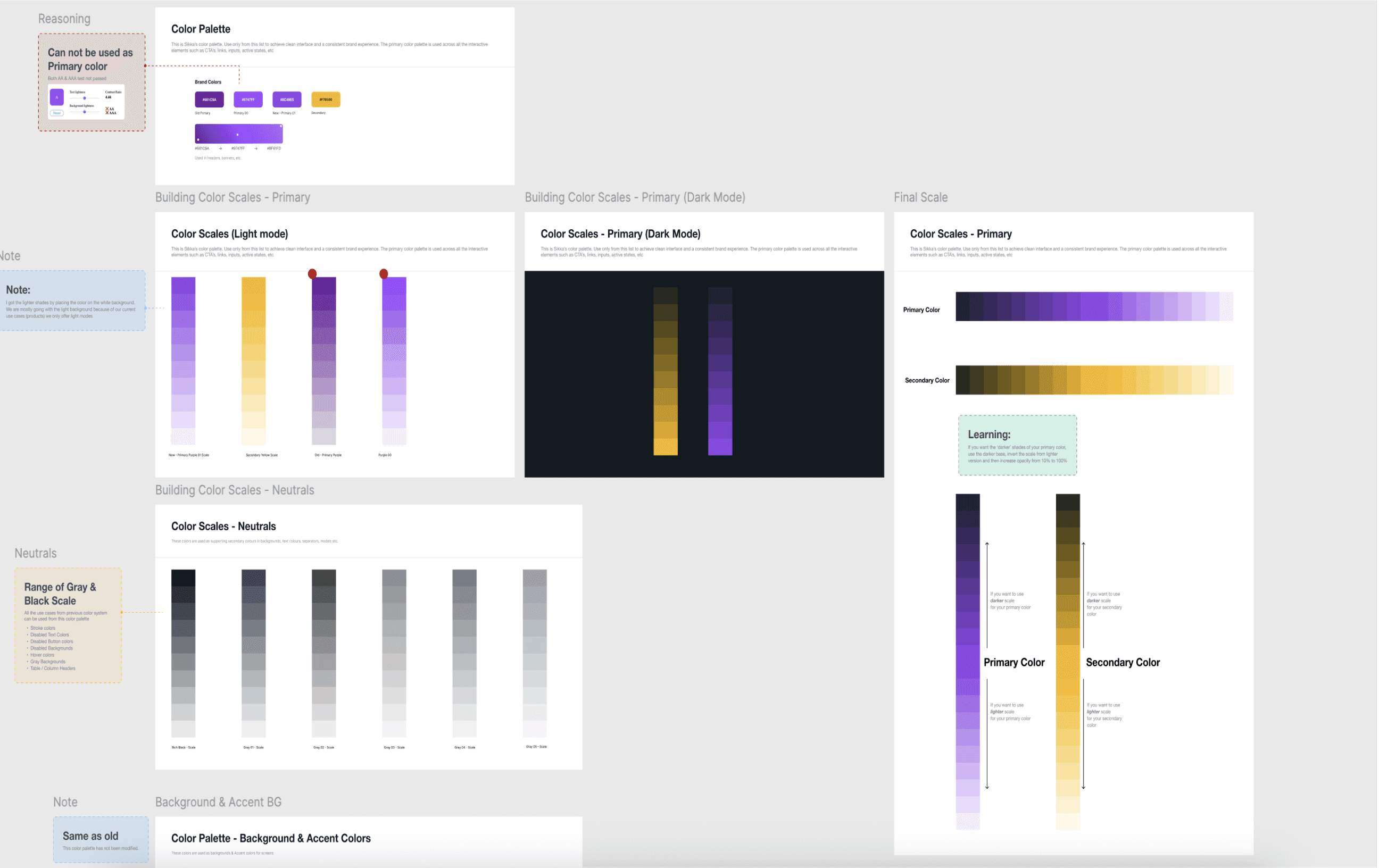
Building color scales has always been one of those necessary but painfully manual parts of creating a design system. My earlier process was reliable, but inefficient. For every primary or secondary color, I would place it on both light and dark backgrounds, duplicate it repeatedly, reduce the opacity by 10% increments, and then use a color picker to extract each resulting shade. This had to be done separately for different backgrounds to ensure accuracy and accessibility. While it worked, it was time-consuming, repetitive, and mentally exhausting — especially when scaling a system across multiple colors.
That friction became the motivation for this experiment.
Try Color Scaling Tool
I wanted to automate the logic I was already following — not reinvent color theory, but encode my designer brain into a tool. Using Replit, I built an AI-assisted workflow that generates color scales automatically for both light and dark backgrounds. By guiding the tool with my existing process (including short walkthrough videos and prompt iteration), I trained it to replicate how I think about opacity, contrast, and consistency — and then do it instantly.
The result is a tool that produces structured color scales along with basic AI-driven color analysis, removing the manual steps entirely while preserving design intent. What previously took significant time can now be generated in seconds, with far less room for error.
You can explore the experiment here:
👉 https://color-blend-ai--tanvipisal96.replit.app
WHAT’S NEXT
This is just the starting point. Next, I’d like to:
Add input fields that allow users to define their own light and dark background colors using hex codes.
Let users choose their opacity range (instead of a fixed 10%), giving them more control over how subtle or aggressive their scales are.
This experiment reinforced something I deeply enjoy: using AI not as a shortcut, but as a way to remove friction from well-understood design workflows — freeing designers to spend more time on decisions that actually matter.